
Friday Walkthrough - Updated Super Bowl Probabilities for Divisional Weekend

Last week, I looked at just how wide open this year’s playoffs are compared to prior seasons by simulating the postseason using a simple pre-game win probability model.
Flawed Parity - Is this the Most Wide Open NFL Playoffs Ever?

One thing I noticed while writing my playoff previews for the AFC and NFC was that even the best teams have potentially fatal flaws — flaws that could end a season much earlier than expected.
Turns out they’re extremely wide open. I’m choosing to use parity as the explanation for why my Seahawks–Jaguars Super Bowl prediction was put to rest almost immediately after Jacksonville lost to Buffalo.
With the Wild Card round now in the books, I wanted to rerun the simulation to see how the Super Bowl probabilities have shifted heading into the Divisional round. A few interesting developments stood out.
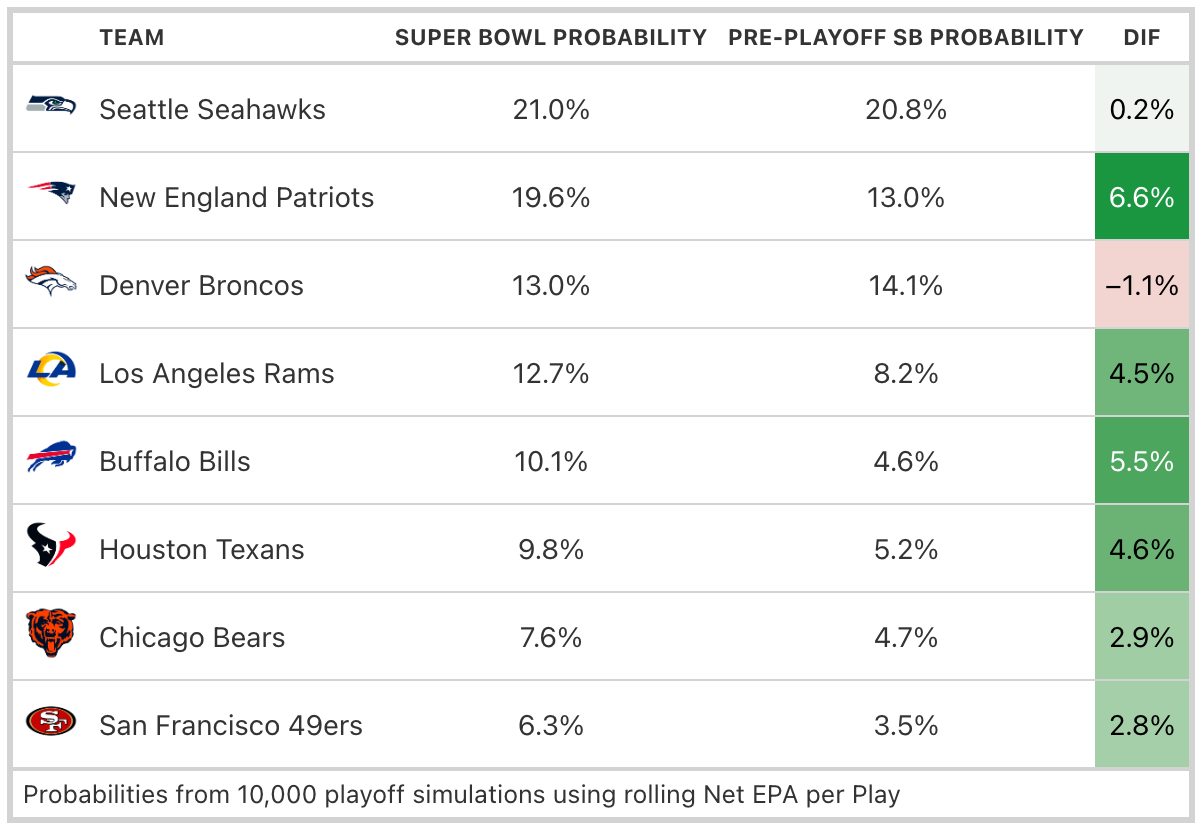
For those curious about why the Seahawks didn’t gain much ground — and why Denver actually lost some probability — the explanation lies in how Super Bowl odds redistribute once games are played. Probability doesn’t flow to the best teams; it flows along the remaining paths. Teams with byes already had relatively stable routes, leaving limited upside once Wild Card games were resolved. In Denver’s case, early results increased the likelihood of facing less favorable matchups, slightly worsening their path despite not playing. The fact that top seeds can lose probability without taking the field only reinforces how wide-open this playoff field truly is.
Seattle still owns the highest Super Bowl probability, but the gap has narrowed. Most notably, the Rams’ chances have jumped to nearly 13%. I think the model underrated Los Angeles heading into the Wild Card round due to how heavily it weights home-field advantage, and I’m not convinced it has fully corrected for that yet.
On the AFC side, New England (+6.6 percentage points) and Buffalo (+5.5) saw the two largest increases in Super Bowl probability from Wild Card weekend to the Divisional round. As a result, the Patriots have overtaken Denver in Super Bowl odds.
Despite having to go on the road in this scenario, I’m not sure New England would mind a potential AFC Championship matchup with Denver compared to Buffalo. And if the Bills do get past the Broncos, Houston looms as a particularly unfavorable matchup — the Texans recorded eight sacks against Buffalo back in Week 12, a performance that still matters when thinking about playoff paths.
Divisional Round Matchup Thoughts
Bills at Broncos
This is probably the most difficult game to get a strong read on this weekend. Denver has a path to controlling the game by stressing Buffalo’s run defense, particularly in the altitude, even with Ed Oliver back in the lineup. But Buffalo’s disguised coverages could create real problems for Bo Nix if Denver is forced into obvious passing situations.
The swing factor, though, is pressure. If the Broncos can consistently get home against Josh Allen, the Bills’ advantages on in the pass game on the other side of the ball may not be enough to overcome. I’m going with Denver.
49ers at Seahawks
Not long removed from their Week 18 matchup, a game Seattle largely controlled for most of the night. With home-field advantage and a San Francisco roster that’s still dealing with injuries, I think the Seahawks are in a good spot here. I have Seattle winning comfortably.
Texans at Patriots
Drake Maye’s one real vulnerability during his MVP-caliber season has been taking sacks — his 8.72% sack rate is well above the league average (6.87%). Houston’s combination of tight coverage and an aggressive front could consistently force New England into unfavorable down-and-distance situations. That’s enough for me to lean Texans.
Rams at Bears
I lean Rams, but this is the game I’m most interested in stylistically. Chicago has home-field advantage, and the weather could matter. More importantly, Caleb Williams’ ability to create outside of structure is a real stress test for the Rams’ secondary.
Los Angeles’ cornerbacks already struggle to sustain coverage for extended plays, and Williams’ average time to throw (3.2 seconds, second only to Shedeur Sanders) pushes defenses beyond their breaking point. I think this stays close throughout, but I’ll take the Rams.
If you enjoy my work and want to support it, you can do so here: https://buymeacoffee.com/josephferraiola